















Entries in design snapshot (140)
Design snapshot: PEM historic arched-top tall windows
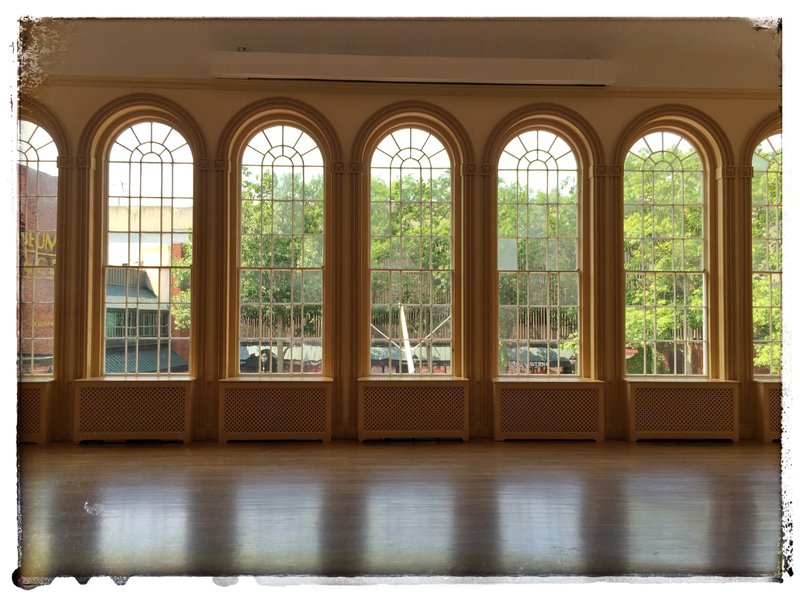 I was back in Salem, Mass. over the weekend for a photo shoot (updating the KHS website) and stopped by my favorite room in the upper level of East India Marine Hall at the Peabody Essex Museum. Constructed in 1825 to house artifacts collected by the East India Marine Society from beyond the Cape of Good Hope or Cape Horn, the Hall's original architect is currently unknown.
The height and shape of the windows in combination with their arrangement and glazing pattern make a striking impression. Despite their towering size, I believe the windows are single-hung. The surrounding trim emphasizes the windows' shape much as eye liner calls even greater attention to the eyes they trace. The windows' reflections on the floor are not to be overlooked, nor the different types of glass that form the window panes. I don't know if the original design called for the use of different glass types, but the result creates a somewhat abstract collage-like more modern effect.
The airy daylight in this grand space inspires most visitors to lower their voices and stand in admiration of the space before venturing to the rooms edges to look at the artifacts housed there. It's a must see/must experience if you find yourself at the PEM.
by Katie Hutchison for House Enthusiast
Design snapshot: Norwegian wood
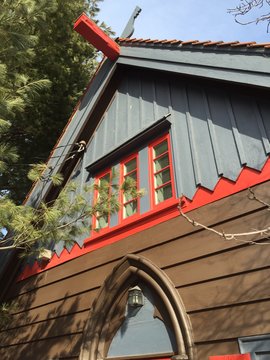 I'm part Norwegian. A distant part. I've never been to Norway, but I enjoy making krumkakes for Christmas as my great grandmother did. That's about the extent of my tenuous Norwegian connection. Yet I find myself unwittingly drawn toward structures bearing the slightest hint of Norwegian influence. So it is no surprise that when I was ambling about between design shops in Cambridge a few weekends ago, I stopped dead in my tracks when I came upon the Cambridge Skating Club. I had no idea it was the Cambridge Skating Club, at the time. In fact, from the gable end, I thought it was an impressive residence.
I quickly wielded my iPhone camera and began snapping shots, some up-close of the entrance gable end, hoping my proximity wouldn't elicit a less-than-charmed homeowner (as has happened before). I was in luck. I scurried around to the side and there discovered the identity of the structure. Later, I learned from the Club's website that the Club was constructed around 1930 in a "cheerful Norwegian style".
Vertical board and battens with picket tips in the upper gable-end teamed with horizontal clapboards punctuated with a pointed arch over the entry door, an open rake, and the dynamic color scheme all speak to its Norwegian inspiration. And that's a terra-cotta tile roof, too. Projecting out at the top of the gable trim, is, I believe, a carved red dragon head, which (from what I've just read online) was a Norse motif found in Dragestil (dragon-style) houses in Scandinavia in the late 1800's and early 1900's. Now, I think I want a carved dragon head on the front gable end of my place. Not sure what the neighbors would make of it.
by Katie Hutchison for House Enthusiast
Design snapshot: Flower bed
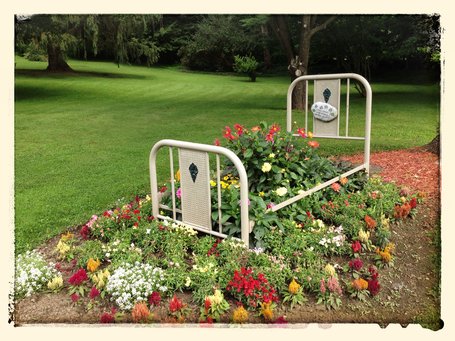 Here's another clever object-turned-planter à la the planted bench that I posted not long ago. What's especially brilliant about this intervention is that the bed frame isn't actually planted. It's merely placed such that the plantings appear to emerge from the frame and spill over like generous bed clothes. Our expectations of what a bed is and how its frame might be planted enable the gardener's slight of hand.
Plus, it's fun to see a well-realized pun flourish.
by Katie Hutchison for House Enthusiast
 Katie Hutchison
in design snapshot, garden tours
|
Comments Off
Katie Hutchison
in design snapshot, garden tours
|
Comments Off
Design snapshot: Potted garden bench
 I have a weakness for re-purposed objects in the garden. Years ago, one of my favorite features in my mother's garden was my grandfather's antique side chair that my mother transformed by replacing the tired seat upholstery with a planted seat of moss and meadow flowers. This sweet bench with curvy arms, curvy back, and a curvy heart cutout punctuated by five offset terra cotta flower pots strikes a similarly charming chord. (BTW I spotted this bench at The Victorian Inn in Edgartown, MA.)
Re-purposed garden objects sited outside the garden can also be a delight. You may recall the wheelbarrow planter I featured some time ago.
There's simply something about the garden that invites us to play with expectations -- by transforming an object that's generally found indoors, into a strictly outdoor object, or re-imagining something meant as a work tool into a decorative display piece. What object might you transform as a foil for your garden? I'm thinking an old, galvanized watering can might make for a nice planter; just remember to drill drainage holes in the bottom. Drop me a note with your ideas over at the KHS Facebook Page.
by Katie Hutchison for House Enthusiast
Katie Hutchison
in design snapshot, garden tours
|
Comments Off
Design snapshot: Tale of two garage doors
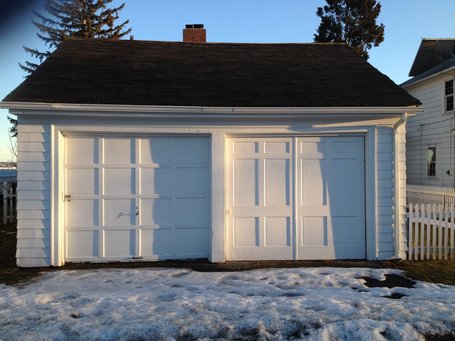 Rarely will you find a better side-by-side garage-door comparison than the one contained on this simple two-stall garage.
The left-hand door befits a typical suburban home, and the right-hand door a more rural outbuilding. Hard to know how these two doors came to be side by side, but I suspect that both openings once sported doors like those in the right-hand opening, but that the door in the left-hand opening was ultimately replaced with an updated overhead door for ease of use.
It will come as no surprise to fellow House Enthusiasts, that in the case of informal, more rural, or more traditional outbuildings serving as garages, I'm partial to the door style -- which I would describe as carriage-style doors -- in the right-hand opening. Such doors often swing open, or in this case, slide open. Both types of operation are seen as somewhat laborious today, so many current manufacturers, such as Designer Doors, create carriage-style doors that are built in sections (like the more suburban-style door in the left-hand opening), so they, too, can open overhead for convenience.
I'd love to see a new overhead door in the left-hand opening designed to match the carriage-style doors in the right-hand opening. It would be win-win in terms of the look and function. Now if only one would materialize.
by Katie Hutchison for House Enthusiast